

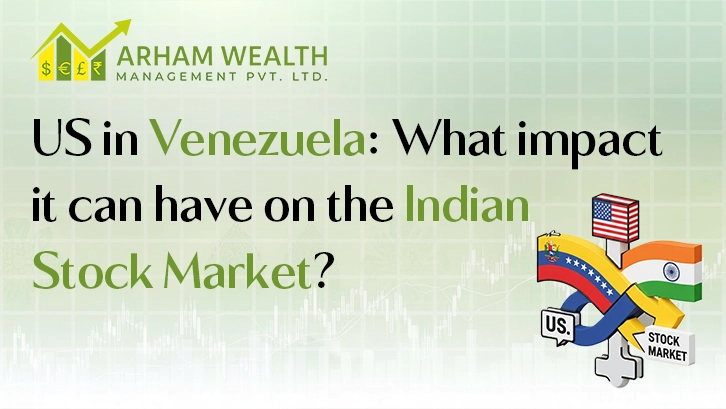





The recent involvement of the United States in Venezuela has once again brought geopolitics to the centre of global financial markets. Venezuela is not just another politically unstable nation. It holds the largest proven crude oil reserves in the world, estimated at over 300 billion barrels, which is nearly 18 percent of global reserves. Any disruption, intervention, or policy shift in such a country automatically raises concerns about oil supply, commodity prices, inflation, currencies, and stock markets worldwide.
For investors in India, the question is not about headlines or political narratives. The real question is how this development can affect oil prices, the rupee, capital flows, and sectoral performance in the Indian stock market. The answer is layered, numerical, and far more balanced than initial reactions might suggest.
Gold and silver are the first assets to react whenever geopolitical uncertainty rises. Historically, during global conflicts or military escalations, investors temporarily shift capital from risk assets like equities into safe haven assets.
After news related to US involvement in Venezuela, gold prices saw a short term uptick. In global markets, gold typically reacts within hours to geopolitical shocks, often rising 1 to 3 percent in the initial phase. Silver, being both a precious and industrial metal, tends to move with higher volatility, sometimes gaining 2 to 4 percent in short bursts.
However, it is important to understand the nature of these moves. Such rallies are usually driven by fear and positioning, not long term fundamentals. Unless the situation escalates into a prolonged global conflict or leads to a sustained oil shock, precious metals often give back gains once clarity emerges.
For Indian investors, this means gold and silver may act as a temporary hedge but not necessarily a long term trend changer. Domestic gold prices are also influenced by the rupee. If the currency remains stable, upside in gold remains capped even during global uncertainty.
Crude oil is the most critical transmission channel between Venezuela and global markets. Venezuela’s oil reserves are massive, but actual production has collapsed over the years due to sanctions, underinvestment, and infrastructure decay. At its peak, Venezuela produced over 3.2 million barrels per day. Today, production fluctuates around 800,000 to 900,000 barrels per day, less than one third of its historical capacity.
This gap is crucial. Markets are not reacting aggressively because Venezuelan oil has not been a major contributor to global supply in recent years. Even if tensions rise, the immediate supply disruption is limited because output is already constrained.
From India’s perspective, crude oil prices matter more than the source. India imports nearly 85 percent of its crude oil requirement. A $10 per barrel increase in crude prices can raise India’s annual import bill by approximately $15 billion, while also pushing inflation higher by 30 to 40 basis points.
So far, global crude benchmarks have remained relatively stable. Prices have moved within a narrow range, reflecting the market’s view that the situation is not yet supply threatening. This stability is the main reason Indian markets have avoided panic.
Indian equity markets tend to react sharply only when geopolitical events affect macro fundamentals. In this case, the reaction has been muted. Broad market indices have remained stable because:
Oil sensitive sectors such as aviation, logistics, paints, and chemicals closely track crude prices. Since oil has not spiked, these sectors have not seen stress.
Banking and financial services remain largely unaffected because asset quality, credit growth, and liquidity conditions are unchanged.
IT and export oriented sectors do not face direct exposure to Venezuela related developments. Their performance continues to depend on global demand and currency movement rather than geopolitics.
Overall, unless crude prices move sharply higher and stay elevated, sectoral performance in Indian equities is expected to remain earnings driven rather than event driven.
The Indian rupee has a strong inverse relationship with crude oil prices. When oil prices rise sharply, India’s trade deficit widens, increasing demand for dollars and weakening the rupee.
Historically, a sustained $10 per barrel rise in crude can weaken the rupee by 50 to 70 paise against the US dollar, assuming other variables remain constant. In the current scenario, since oil prices are stable, the rupee has avoided sharp depreciation.
In the commodities futures and options segment, volatility tends to increase during geopolitical events. Crude oil, gold, and silver contracts often see higher volumes and wider price swings. However, these moves are usually short lived and sentiment driven.
For traders, this creates tactical opportunities. For long term investors, such volatility does not change the structural outlook unless it turns into a sustained trend.
From a long term perspective, the US involvement in Venezuela does not fundamentally alter India’s economic or market trajectory. India has gradually diversified its energy sourcing over the last decade, reducing reliance on any single geography.
Even if Venezuelan oil supply improves in the future, it will be a slow and phased process. Restarting oil fields, upgrading infrastructure, and restoring export capacity can take years, not months. For Indian markets, the key long term variables remain:
Geopolitical events like this may create temporary noise, but they rarely derail long term market trends unless they lead to sustained macro shocks.
The US presence in Venezuela is a significant geopolitical development, but its direct impact on the Indian stock market is currently limited. The biggest risk factor remains crude oil prices. As long as oil stays within a manageable range, Indian equities, the rupee, and commodities are unlikely to face long lasting disruption.
Gold and silver may see short term volatility, commodities futures may experience brief spikes, and sentiment may fluctuate, but fundamentals remain unchanged. For Indian investors, this is a situation to monitor closely, not a reason to panic.
Markets reward patience, data, and discipline far more than reactions to headlines.
Disclaimer: Investment in securities market are subject to market risks, read all the related documents carefully before investing. | This blog is just for information purposes & data is sourced from publicly available reports. | Name of member: Arham Wealth Management Private Limited | SEBI Registration: INZ000189034, DP: IN-DP-456-2020 | Read Full Disclaimer: https://www.arhamwealth.com/disclaimer
Source: Times of India | Financial Express | Mint | Economic Times
Best Security
Best Infrastructure
Best Platform
Dedicated Support
24/7 Support